
Friday, July 10, 2015

Thursday, October 30, 2014
Pirates!
After spending a recent day with my
youngest granddaughter visiting the new little “pirate” park off
of Hinton Avenue and firing off the canon on the “pirate” ship at
The Children's Museum of Wilmington, I was prompted to dig out an old
“pirate” unit that I used back in 2007. When I found the “pirate”
supplies in my attic, I was surprised to see that the stack of
accumulated materials was almost 4 feet high. Hearing my husband's
voice in my head that says “some day the attic is going to cave in
on us because houses were not built to hold that amount of sh#%&,”
I decided to pull out the “pirate” unit and share it.


During my years in the classroom, I
always appreciated donations made by retired teachers. I especially
appreciated the materials that came sorted and notated. So my goal
for my “pirate' unit was to sort it, catalog it, and divide it
appropriately by age level and usefulness.
As I started the process of unpacking
and spreading all the materials out over two bedrooms, I was reminded
how gifted our staff was, how great our resources were, and how much
the children enjoyed the activities. The “pirate” unit back in
2007 was our kick-off, back-to-school theme and it carried us even to
the end of the year with a field trip to that “pirate” ship at
The Children's Museum of Wilmington.
Of course we didn't have a “pirate”
ship at school so we built one. My husband was retired and I enlisted
his help in building one. With only three refrigerator boxes and Mr.
McGroovy's BOX RIVETS, anybody can have a “pirate” ship large
enough to accommodate an entire class of preschoolers. The children
really took ownership of the project because they helped paint it. It
was so cute that WECT-TV came out and filmed the three year old class
and showed them on the six o'clock news. As seen below in WILMINGTON
PARENT, it was also featured in our school advertising for many
years.
This unit was very amazing because it
cut across so many areas of our curriculum---art center, free play,
dress-up, puppets, music, circle time, bulletin boards, classroom
speakers, snack time, field trips, playground, library books, etc. It
was all encompassing. It was embraced by staff and children alike.
Plus it was very flexible and adaptable as to age level
appropriateness. Like in painting the ship, the two's could paint as
long and as high as they wanted and the kindergarten could paint as
long and as high as they liked. It was definitely a “one size fits
all” unit.
In addition this unit was a showcase
for our staff. It let the parents see how gifted, enthusiastic and
resourceful the teachers could be. Our bulletin boards were amazing,
all the activities were happily embraced by the children, and the
parents appreciated the value on the return from their investment in
our program.
I have always been a proponent of
local resources like the public library, retail establishments, and
parent volunteers. In 2007 the New Hanover County Public Library
provided us with a “theme bag” full of “pirate” titles. Each
child was sent home with a “pirate” bookmark (seen below) listing
all the titles being read during the unit. Local pet stores generally
are willing to allow classes to visit and often times parents are
willing to bring a family pet to the classroom. Real parrots were
definitely a part of this unit.
This unit allowed us to immerse the
children in “pirate” music, language, songs, and finger plays. As
was our custom, each art center time project was sent home with an
appropriate song or finger play. The accompanying songs and finger
plays informed the parents as to the correct lyrics or words being
said by their children. Our music teacher did a fantastic job of
providing a variety of musical experiences during her time with each
age level. In addition to singing songs, the music teacher provided
opportunities to listen to “pirate” musical instruments----drums,
flutes, accordions, fiddles, etc. (1).
She would teach them to move or dance like a pirate, act like a
pirate, or even work like a pirate. Two of the favorite songs were
BLOW THE MAN DOWN and MY BONNIE LIES OVER THE OCEAN.
Since the unit was a kick-off for a
new school year, there were fun “pirate-like” activities to do
during circle time instead of the usual, get-to-know-you activities.
Since a “pirate” has to know how to use a “spyglass,” we
played a form of “I Spy” during circle time. Each child got a
turn with the “spyglass” to look across the circle and name the
child in view. The children created “pirate” names by adding
“pirate” titles to their own names. Circle time was also filled
with puppets, finger plays and “pirate” vocabulary words.
Talking like a parrot was fun also.
Since our playground was huge and very
sandy we had plenty of opportunities to play with treasure maps and
toy compasses. The children used sandbox shovels to dig up the buried
treasure---jewels, rings, coins, etc.(2)
The children also created their own treasure maps using the side of a
brown paper bag, rubber stamps, and markers to make big X's to “mark
the spots.” To give the maps a little authenticity and aged look we
had the children crumple and wad up the maps after they drew them.
When the maps are smoothed out, they look very old! The toy compasses
were adequate enough to introduce N, S, E, and W as directions to
travel (early literacy!).
We had a set of guiding principals
concerning art center time at our school. Art center time occurred
everyday, teachers worked one-to-one with their students, and
activities were selected according to the weekly skill chart
(MT---cutting, W---gluing, and THF---painting). In addition,
activities for art center time were created or selected with thoughts
concerning “process vs product,” unit being studied, and season
(inside or outside, etc.). As a point of clarification, cutting, for
example, was not strictly with scissors. Cutting could include
tearing, ripping, folding, rubbing, tracing, shelling, etc. or the
use of tweezers, plastic knives, sewing needles, hole punchers, etc.
Gluing always centered around assembly, but painting could occur in
many forms (sponge, finger, easel, stamping, printing, drizzle,
etc.).
With a unit like this one, it was a
challenge to find or develop correlated projects for art center time.
A favorite go-to source for classroom supplies was SHAPES ETC. It is
easy to take a pad of their NOTEPAD creations (large or small) and
turn them into sewing cards, dioramas, puzzles, or stick puppets.
Shown below are examples (with the help of lamination) how we created
projects for art center time--- “pirate” sewing card, digging
diorama, and stick puppet (each project went home with an
accompanying “pirate” song or finger play introduced during music
or circle time).
We always asked parents to save items
for the classrooms. Two of our most desired items were paper towel
rolls and toilet paper rolls.(3)
For this unit we used construction paper wrapped paper towel rolls to
make the cutest “spyglasses.” The biggest hit was when the
children cut a section of paper towel roll in half and glued a large
parrot to the roll. The parrot could be worn cuff style on a wrist or
perched “pirate” style on a shoulder.
Our staff was never shy
about dressing up. One teacher had her own adult “pirate”
costume. She was also very good at doing voices and being very
dramatic while reading aloud. She treated the children to a
“day-with-a-pirate!” She wore her costume to school and stayed in
character as she encountered and conversed with the children. She
shared a lot of “Ahoy me Hearty!,” AR, AR, AR's,” Aye Matey!,”
“Yo Ho, Yo Ho!” and “Shiver me timbers!” (4)
The children also liked
to dress up so we often made wearable items during art center time.(a
hint concerning a project's success was always how quickly the
children donned their items when their parents arrived for pick-up).
The “pirate” earrings made from a rolled strip of aluminum foil
and a rubber band were a hit with the boys and the girls. Three types
of headgear were created during art center time----one was for
cutting, one was for gluing, and one was for painting. We copied one
Captain's hat from Long John Silver's restaurant chain which was done
as a cutting project (this technique was often employed for cutting
which called for the children to cut along a designated line).
Another Captain's hat was a gluing project, but the most popular hat
was the tied on scarf accompanied by an eye-patch and washable
“pirate” tattoo (this project was done on a painting day).
During comprehensive
units we often brought special toys into classroom centers for free
play time. Special garments or objects were added to the dress-up
clothes like pirate costumes, treasure chests filled with old
jewelry, compasses, spyglasses, eye patches, play mops, a “pirate”
Jolly Roger flag, etc. Bendable pirates were added to the block
centers. Large Melissa and Doug floor puzzles and wooden table
puzzles depicting “pirate” scenes were added to the puzzle
collection. Some parents shared “pirate” sets from home like a
“pirate-themed” Mr. Potato Head, a Fisher Price Pirate Ship and
Island with accessories, a Playtown “Timbers B. Shiverin” with
accessories. A large stuffed parrot and a large “pirate” puppet
were added to the puppet stage. A hammock was tied between two trees
on the playground so the children could sleep like “pirates.”
Eating like a “pirate”
was a bit of a challenge, but zwieback or Biscotti could serve as a
substitute for “hard tack.” Canned sardines might be introduced,
but don't plan on much sampling!
With big kick-off units
we always created “welcome” scenes for the preschoolers for the
first week of school. For this unit the children were greeted by six
foot tall “pirate” inflatables at each entrance. Later the
inflatables were used to create a “photo booth” scene at the
“pirate” ship. All the classes dressed up for picture taking
sessions at the end of the unit.
- CD: PRACTICAL POP AND BUCCANEER ROCK FOR SCALLYWAGGS OF ALL AGES
- ORIENTAL TRADING COMPANY INC.
- Supplies could be in jeopardy if manufacturers start producing “roll-less” products!
- PIRATE: “Things to do and Make!” and The Great PIRATE Activity Book
Friday, September 5, 2014
275 Celebration Wilmington
I was thrilled back in
1979 when we arrived in Wilmington because I was going to be living
at the beach! However, the beach has not been what has fascinated me
about living in Wilmington for the last 35 years. Instead, I have
grown to appreciate Wilmington's historical significance as a
city/port in one of the 13 original colonies.
As a child, I always
liked history. When I was in middle school, I discovered the book,
JOHNNY TREMAIN by Esther Forbes. It is a children's historical novel
set in Boston prior to and during the outbreak of the American
Revolution.(1) At 12
years of age it was probably the longest and most exciting book that
I had ever read. Having grown up learning to read with “Dick and
Jane” type books, this Newbery Award winner opened up a whole new
world of reading for me.
So discovering the
historical significance of Wilmington was like experiencing JOHNNY
TREMAIN all over again. Initially, I was just in awe of the “oldness”
of everything. I also liked the Wilmington location because my
“southern” experience was going to be broadened. In our last
location which was in Louisiana, our “southern” experience had
more to do with Huey Long (you know FDR had him shot!) and the “War
of Northern Aggression.”
Right after Hurricane
David we acquired a home along Masonboro Sound Road. It turned out to
be a very fortuitous selection. It was this road that gave me my
JOHNNY TREMAIN moment about Wilmington. One day while biking along
Masonboro Sound Road, I spotted a tombstone. It caught my attention
because of its location on the edge of the road instead of being in a
cemetery. I stopped to get a closer look at the
inscription---”Residence of William Hooper, Signer of the
Declaration of Independence, New Hanover Historical Commission, J. J.
Howell, E.S. Martin, James Sprunt, and W. A. McGirt ” I was
thunderstruck to think that I was experiencing a view of the water
just like a signer of the Declaration of Independence. It was
thrilling to know that I was standing in an area that had been lived
on over 200 years earlier. If Facebook had been around in 1979, I
would have made a “selfie” and posted it on my page.
I carried this
fascination with Wilmington being the home to William Hooper into my
classroom every summer when we studied about and celebrated the
Fourth of July. I've been known to take a classroom of children to
the tombstone marker site so they could experience the same view of
the water as William Hooper. We often would reenact the signing of
the Declaration of Independence by having the children sign their
names with quills, a jar of ink, and parchment paper. Sometimes the
children would even go home and tell their parents what I had said
about the marker. Below is a picture of students visiting the
marker! (2)

My next JOHNNY TREMAIN
experience with Wilmington occurred as a result of our daughter doing
a project for Southern Studies at Cape Fear Academy.
The assignment called
for a “family history” report. In helping our daughter gather all
the information that she needed, I discovered that my husband's
family had a Revolutionary War patriot on their family tree. Gutridge
Garland was born in Halifax County, North Carolina in 1753 and lived
in Rowan County, North Carolina. His wife's father, Andrew Hampton,
was a colonel during the American Revolution. Even though Gutridge
did not fight at the Moore's Creek Battlefield, it still makes living
in Wilmington very special for our family. Our children and
grandchildren will feel and know that their ancestors helped win the
“Battle for Independence” and kept Wilmington safe for future
generations.
(1)
JOHNNY TREMAIN, Wikipedia
(2)
Avery and Sam Theriault
Tuesday, August 26, 2014
New Version of Bible School
Recently I spent 5
evenings helping with Bible School at our church. This is an
undertaking that I had not experienced in the last 25 years because
our youngest is 36 years old. Bible School has definitely evolved
even more since the days of my youth when marching around and singing
ONWARD, CHRISTIAN SOLDIERS was the most active part of the morning.
I was very pleased to
find that some very sound educational theories had been tapped in the
preparation of the curriculum materials. The Bible School lessons
were steeped in the concrete with full immersion lessons prepared to
teach the concepts of the Bible stories. This particular curriculum
was WILDERNESS ESCAPE: “Where God Guides and Provides!”
The children were divided
by age level and assigned to one of 8 tribes (Asher, Benjamin, Gad,
Joseph, Judah, Levi, Rueben, and Simeon). My tribe was Simeon which
consisted of a small group of rising 2nd graders. We had a
tribal rug to sit upon. We, like the real Israelites, rolled up our
rug and carried it with us as we traveled. We also traveled with a
basket to carry our goods from the Market Place. We had tribal
meetings and we wrote a tribal cheer to the tune of BINGO! (a little
artistic license was taken to make the name fit the song, but the
kids felt comfortable with it)
“There was a tribe that
had a name and Simeon was its name-o!
“S-i-meon! S-i-meon!
S-i-meon!”
“And Simeon was its
name-o!”
The Market Place was a
very “hands-on” experience for the children. It was a great
improvement over the traditional approach to classroom “arts 'n
crafts.” Each decorated tent in the Market Place represented some
aspect of life for the Israelites (tents are pictured below). In the
tent posted as daily life or chores the children washed clothes,
kneaded bread, pumped water, churned butter, and crushed grapes. In
the tent representing the artisans the children molded clay, sewed
sandals, wove mats, braided ropes, and strung tambourines. In the
tent where food was sampled the children tasted manna (cereal),
hummus, figs, grapes, cheese, and sand!


Built into the evenings
were opportunities to play outside and experience some of the
physical challenges that the Israelites faced in the desert. Relay
races were created to simulate the problems faced by the tribal
members like camel spit, long marches, melting headdresses, packing
and unpacking, and physical stamina. The favorite relay was the
“inflatable bounce house” obstacle course. Below are pictures to
illustrate how serious the tribe members were about being fast and
strong!


During the final tribal
meeting of each evening, the children heard a Bible verse and were
asked to report God sightings. The reported God sightings were
printed on “footprint” stickers which were added to the posters
illustrating Moses' trek. One little guy in our tribe was so sincere
when he knew that finding his lost pig, Pork Chop, and his lost truck
while on vacation were truly God sightings.
Each evening also
included a visit with Moses at his tent. Moses was dressed
appropriately in a period costume. Each visit with Moses told of the
journey and the reactions of the Israelites. The first evening
included following Moses through the parted Red Sea. (This made a
real impression with the children because they repeatedly asked to go
through the Red Sea as the tribe traveled together from tent to
tent.) The second visit with Moses concerned “complaining people”
and how God rained down quail and provided “manna.” Each tribe
member roasted a “Peep” quail over the camp fire and gathered
cereal “manna” off the ground. After this visit I did feel the
need to bring along Egermeier's BIBLE STORY BOOK to help with a few
Biblical pictures for clarification. The third visit with Moses
concerned the battle with the Amalekites. The children took turns
like Aaron and Hud to help Moses hold up his rod so that the
Israelites could defeat the Amalekites. The fourth visit was about
Passover and the visit from the Death Angel. The children smeared
“blood” paint on their tent and ate unleavened “pita-style”
bread. The last visit with Moses covered the meaning of each of the
Ten Commandments with a reciting and discussion.


My biggest obstacle to
overcome in order to help the children have a joyful experience was
my lack of familiarity with the “current” music used for worship
and praise. Each evening opened with musical celebration and closed
with musical celebration. The new “praise” music genre is very
unfamiliar to me. The first night I felt very stiff and uncomfortable
with the new style of music, but by the last evening I was moving to
the beat of the new rhythms and much more comfortable with the new
style. I eventually felt comfortable participating in a “hora”
circle dance and singing along with SHALOM at the end of each
evening.
It felt strange with
Bible School being in the evenings. I understand the need for
adjusting the timetable in order to get the needed volunteers from
among working parents. I also understand the idea of providing supper
so that families could come straight to the church from work and day
care. However, I still believe that the children are more receptive
and attentive in the mornings. I felt that the children were a little
rushed in their visits with Moses because of the tight, short time
frame (5:30pm to 8:00pm). Supper time was included in that short time
frame which also caused the children to be rushed while working on
their crafts in the Market Place.
Overall Bible School was
a nice, new experience to add to my “retirement” repertoire. I
would definitely volunteer again next year!
Monday, July 7, 2014
Career Day - A Peek Into The Future
During my recent subbing stint with 6th
graders, I was left to create lesson plans for a group who only
wanted school to be over. As I always do, I checked my calendar
resources. Fortunately the school calendar listed a Career Day
involving parent participation. I didn't know any of the parents so I
was left with no choice, but to create some activities for the class!
Since the class was comfortable with
“morning sheets” I created a matching sheet with job titles
listed down the left side and job descriptions on the right side.
(There is a sample of the matching sheet attached.) I also stirred
things up by rearranging their desks into a double horseshoe so that
we could have group discussions. I allowed them to refer to classroom
dictionaries and to each other for matches. When they did ask for
help, I tried only to give them hints about the jobs. Unfortunately
all the dictionaries in the classroom were not of equal quality so a
lot of sharing had to occur. When a sufficient amount of time had
elapsed, a group discussion of the 24 jobs took place. I tried to get
them to understand connections to real life situations. For example,
during the discussion for entomologist, I asked them why it would be
important to be an expert on insects----bees as pollinators for our
food source, bugs as a source of food for pets, etc.

Taped up pages of want ads from the
local STAR News at the front of the classroom. Asked them to think
about what jobs are available and what skills were needed to perform
those jobs. Left this activity up as a free choice activity during
lunch and breaks. Class discussions will return to these pages later.
Next I spread out an assortment of
magazines---POPULAR MECHANICS, POPULAR SCIENCE, OUR STATE, SOUTHERN
LIVING. There were enough magazines so that each student could pick
two. The class was given time to peruse the periodicals and look for
articles about jobs that might interest them. Next each student was
asked to share with the class an occupation of interest found in one
of the magazines and tell what they might need to do to get that kind
of job. These particular periodicals were great because they had a
lot of pictures showing people doing various jobs currently or in the
future. Even some of the advertising in the magazines was helpful to
illustrate or prompt a student to think about a career choice.
The next activity involved information
that I had found online from the Michigan Council of Women in
Technology. I shared that Information Technology jobs were good jobs
for the future and that not many women are presently working in this
field. The premise of this type of work is that “computers are
dumb, and they need humans in order to operate!” As soon as 2020,
it is believed that there will be 1.4 million IT jobs available. IT
jobs are considered more stable and offer better pay. At the present
time only 18% of computing and IT science degrees go to women and
companies are looking for women with this type expertise.(1)
I also pointed out that IT companies are looking for creative
people---types who think outside the box! I shared an interview
technique used by many companies that tries to determine how creative
a thinker an applicant is. A job interviewer will hand an applicant a
ballpoint pen and ask him to name or list all the possible uses for
the pen. The job interviewer is looking for creative people who are
not afraid to “take the pen apart.” I shared the story of the
surgeon who saved someone by using the case from a ballpoint pen
during an emergency tracheotomy.
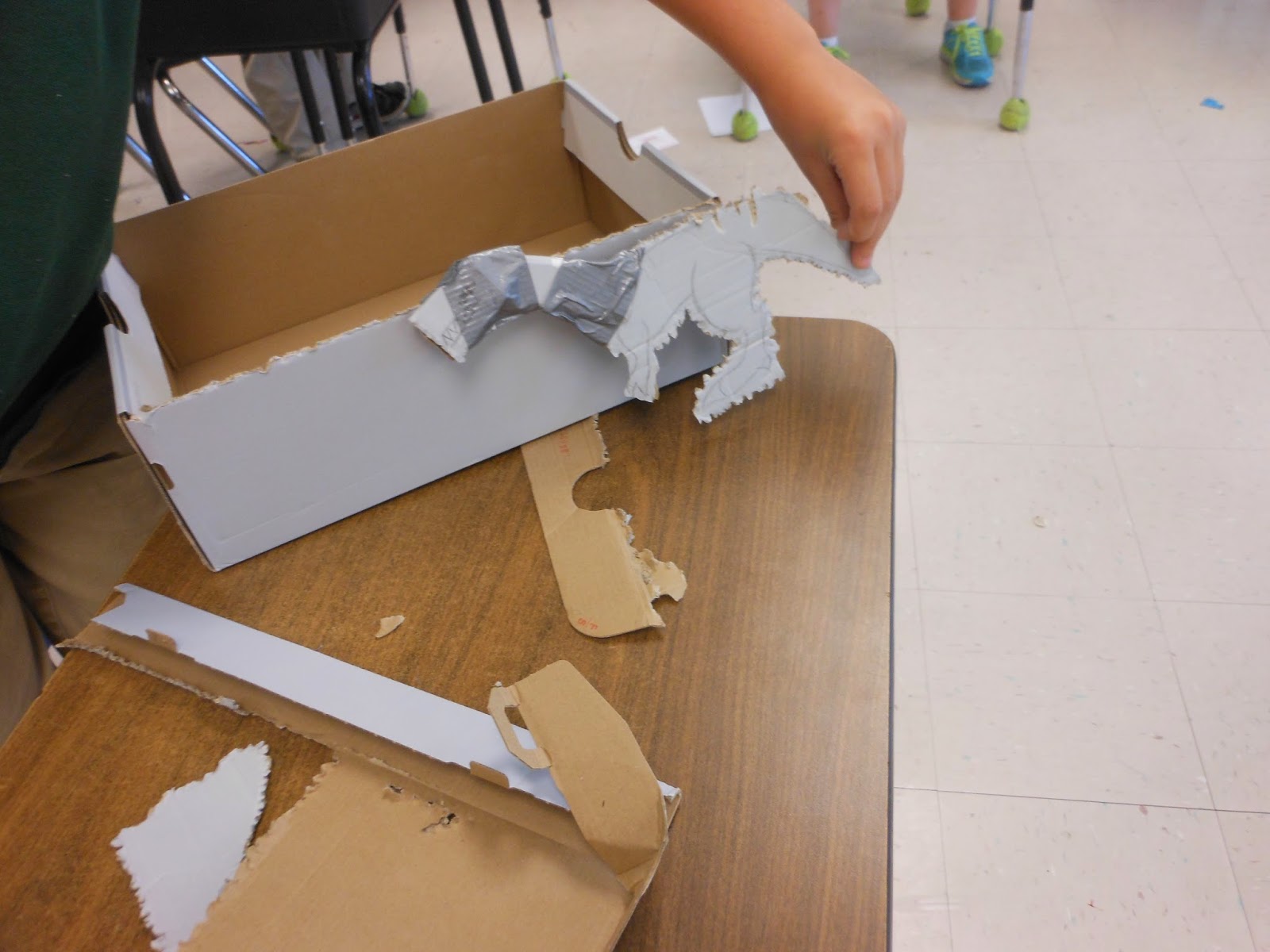
After the IT discussion I presented
them with a challenge. I asked them to create something from a
cardboard box, a pencil, and duct tape. I supplied boxes of various
sizes and shapes, they all had pencils and I provided rolls of duct
tape to be shared. Each student picked one box. They also had to
name their creation and give a little spiel about it to the class. A
secret ballot was held for 1st, 2nd, and 3rd
place and prizes (giant Tootsie Rolls from the Dollar Store) were
awarded. The variety of ideas was amazing----very simple to quite
complex, very quick to quite time consuming, and very typical to
quite unusual. Pictures of the “challenge” creations are attached
to this blog.


The last task before going home was to
list an occupation of interest that could be illustrated to the class
the next day by way of a demonstration, a picture, a story, a prop,
etc. The list included vet, gymnast, marine biologist, singer,
dancer, basketball player, travel agent, football player, skate crew,
engineer, paleontologist, and “velociraptor!” The next day the
students brought in basketballs, footballs, Legos, stuffed animals,
choreographed skits, songs, skate boards, fossils, and a toy dinosaur
robot. The presentations were spread out over the day because of
other Career Day activities. The presentations were generally gender
typical with the girls being the singers and the dancers and the boys
being the ball players and the skate boarders.
On Career Day the 6th
graders did join the 7th and 8th graders to
complete a packet called CAREER DAY PREPARATION ACTIVITIES from the
Vermont Student Assistance Corporation. The students were also
visited by a parent who owns her own recording label and performs, a
parent who is a chemist and tests water, and a parent who is retired
military and works as a warden. Other special activities included
watching episodes of DIRTY JOBS hosted by creator, Mike
Rowe---collecting alligator eggs (my husband watches SWAMP PEOPLE so
I had a little background to share), collecting kelp and feeding it
to abalone (I had been to a similar California pier/restaurant where
the sea lions perch under the glass top tables), and creating special
effects make-up.
Career Day seemed an enjoyable
experience considering it was the last in-class activity before the
last day of school. The remaining week included an all day Field
Trip, Field Day outside, an Awards Ceremony, and Graduation.
(1)
According to “How do we get girls to code? Initiatives seek
answers” by Hayley Tsukayama at THE WASHINGTON POST, Google is
launching an all-star group initiative aimed at getting girls excited
about computer science and coding. The initiative, called “Made
with Code,” will invite teenage girls to start projects in its
“Blockly” visual programming editor. STAR News, Sunday, June 22,
2014
A Classroom Calendar Correlation
During my years in the classroom, I
always liked to teach to the calendar-----meaning I preferred to
build a unit or present a topic in a timely manner with an actual
event, holiday, celebration, season, remembrance, etc. Since a
feeling for history is hard to establish for young children, it makes
more sense to talk about, for example, the Pilgrims at the actual
time of year for harvesting and preparing for winter-----not say in
May! If you want children to have an understanding for the direness
and gratitude felt by the Pilgrims, then the children need to have
some concrete connections to the events. Appropriate seasonal
weather conditions have the power to cement concepts read about in
books or heard about in stories.
Holding to my belief in following the
calendar for the classroom, I used a day subbing with a group of 6th
graders after their EOG's as a way to explore three calendar
events---a full moon combined with Friday the 13th, Flag
Day, and Father's Day. Using my efforts to make their time as
interesting as possible while waiting for the other classes to finish
the Science EOG's, I honed in on the fact that it is the 200th
Anniversary of the STAR SPANGLED BANNER. I found information and an
interactive website in the June issue of the SMITHSONIAN, the
magazine for smithsonian.com.
Luckily, the school is equipped with
Wifi, a laptop, and a projector, so I was able to share the
interactive website with the entire class. Since they have an
American flag on display in their classroom I started the discussion
off with having everyone stand and say the Pledge of Allegiance. Next
we proceeded to read the information on the interactive website with
a game that the class had taught me called “popcorn.” The
students take turns reading until they are tired which then calls for
the reader to say “popcorn!” Hands then go up for volunteers to
be called on to continue the reading. At the end of each section of
the informational reading on the website was a question to be
answered before they could move on to the next section. It was
amazing to see how engaged they were about getting each question
correct in order to read more about the history surrounding the song
and the flag.
After finishing the website, I
presented the class with examples taken from the SMITHSONIAN
magazine which showed artworks that were inspired by the flag which
had been seen by Francis Scott Key. There were examples by painters,
poets, musicians, cartoonists, and weavers. Of course the one to
catch the attention of these 6th graders was the piece
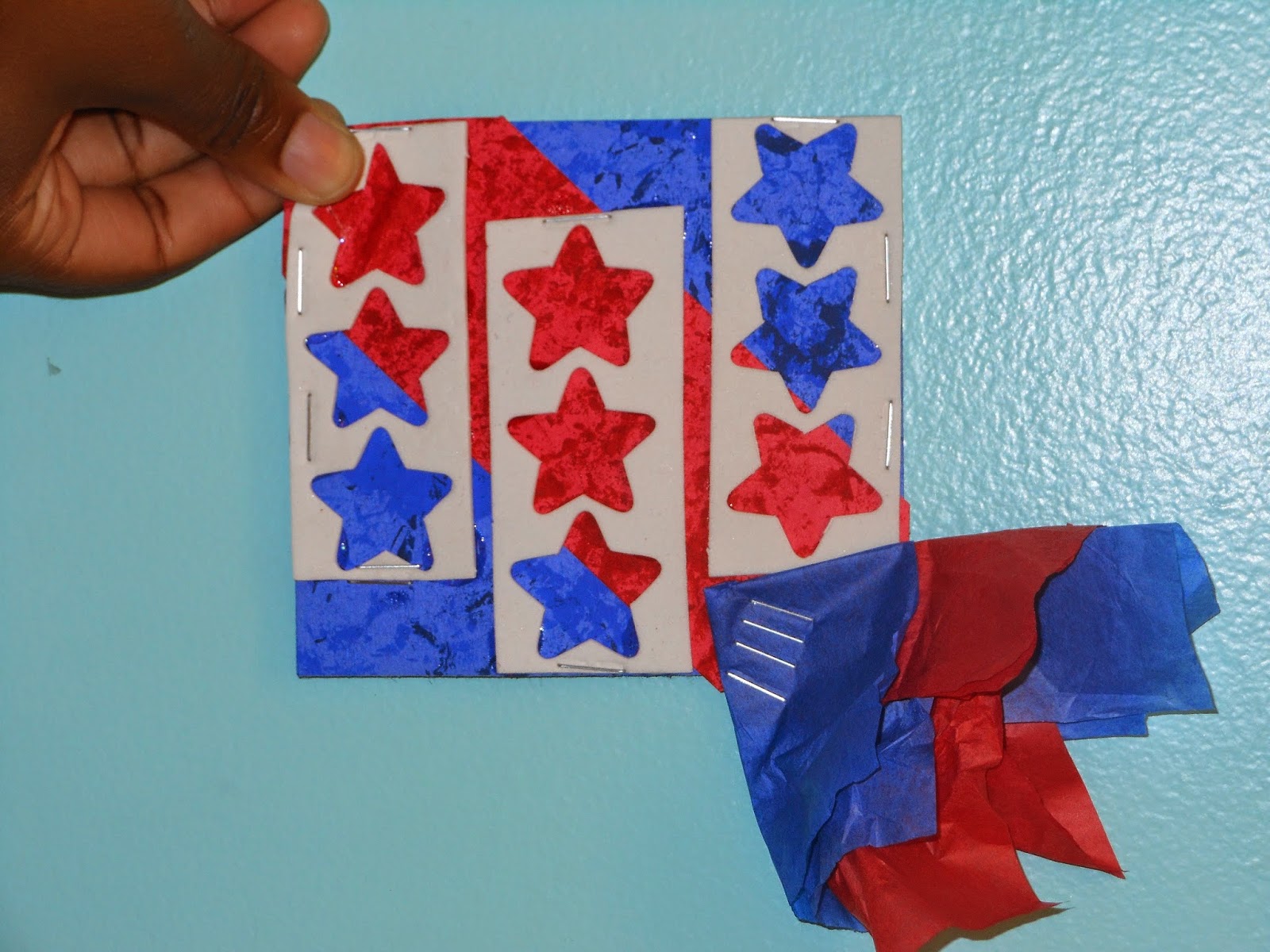
done by the team at Ralph Lauren's studio. Next I challenged them to
create something red, white, and blue to represent how they felt
about the STAR SPANGLED BANNER and that original flag which has been
enshrined at the the Smithsonian since 2008. I put out piles of red,
white, and blue scraps from many old projects---paper strips, foam
punch outs, wire, tissue paper, ribbon, stickers, etc. In the
accompanying pictures are some examples of projects that were created
by the students.




Since these students are going to be
the class to lead the singing of the STAR SPANGLED BANNER at the
school graduation ceremony, I asked them to practice the words. Again
using the SMITHSONIAN interactive website we heard the music and saw
the words. An interesting discussion occurred when they realized that
the words for the STAR SPANGLED BANNER were actually piggy-backed on
another popular British song. They saw that it was like singing a
nursery rhyme. They all knew that the ABC song (which was based on a
Mozart tune) which then became the basis for “Twinkle, Twinkle
Little Star” which is the same tune as “Baa, Baa Black Sheep.”
After several attempts to sing the STAR SPANGLED BANNER, I realized
only one girl in the class knew the words and tune. I am going to
have to print off copies for everyone to practice next week.
Happy Flag Day and Happy Birthday to
the STAR SPANGLED BANNER!!!
Subscribe to:
Posts (Atom)